

"Wolves."
This song is I wrote at like 3am trying to figure out what to do for a small ensemble project. I love upright piano, and I wanted to write something cool I came up with a cool chord progression wrote a hook and the rest is history. Vocals didn’t make it into the song yet but soon. For now, it’s just Piano, Bass Guitar, and Drums which is one of my favorite combinations of instruments. I think if anything is taken from this it should be the emotion all the instruments are working together to provide hope you enjoy.
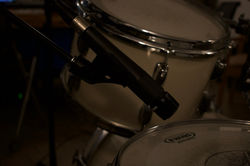
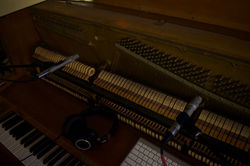
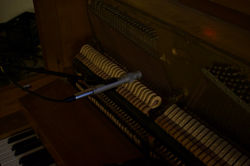
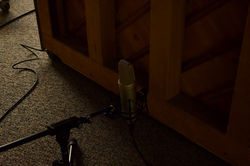
Tracking Pictures
 |  |  |
|---|---|---|
 |  |  |
 |  |  |
 |  |  |
 |  |  |
 |  |  |
 |  |  |
 |  |  |
 |  |  |
 |  |
Tracking Info
Piano:
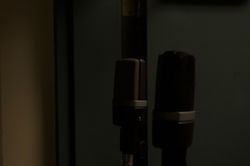
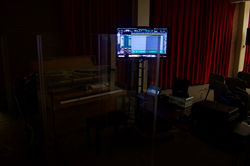
I set up the Baldwin upright piano in Gallagher room 107 at 3 am, taking advantage of the room's quirks, including its reverberated hallway and spacious layout. I used a total of 5 microphones: a pair of Shure KSM141s aimed directly at the piano strings for clarity, a matched pair of AKG C214s positioned in XY stereo configuration in the doorway for capturing the room's ambiance, and a Rode NT2000 condenser microphone placed at the back of the piano for depth. Each microphone was meticulously processed through different preamps and channel strips to achieve an intimate yet upfront sound. Despite encountering some noise issues with the Rode NT2000 mic, I managed to mitigate it during post-production. Experimentation with a tea rag added a unique felt texture to the piano while processing the room mics through the Alesis MV4 provided additional versatility in shaping the overall vibe of the track.
Drums:
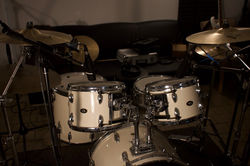
I opted for a different setup this time, using an 80s Slingerland drum kit with Sabian Cymbals, Evans damper rings, and dampening gels for control over the sound. Microphones included an Audix D6 for kick, a Shure SM57 for snare, Sennheiser MD421s for high, mid, and low toms, and Rode NT5 matched pair overheads for capturing the overall kit sound. Tuning the toms to match the key of the piano added cohesion to the recording. Working with Brady Fresh, you achieved a straightforward yet tight drum sound, with additional processing on the snare microphone through the BBE maximizer for added presence and snap.
Bass Guitar:
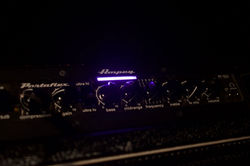
Initially tracked with Spencer Gudeman, bass guitar duties were also handled by Brady due to scheduling conflicts. Using an Ibanez SR300EB bass guitar through an Ampeg Portaflex PF-500 head and amp, I dialed in settings to achieve a smooth, round tone. Capturing both direct input and microphone recordings (AKG D112 on center cone and Sennheiser MD421 off-axis), the bass guitar provided a solid foundation for the piano and drums, contributing to the overall groove of the track.
Post Production & Mix Photos


Editing/Production & Mixing
Overview
In your mixing process, you've meticulously organized each instrument with its own sub-master, color-coding, and detailed comments, ensuring clarity and efficiency. Your track hierarchy starts with the raw source sound and culminates with the "2-BUS," facilitating tasks like glueing elements together, controlling loudness, and adding saturation for cohesion.
Piano
The piano recording required minimal editing, with minor timing adjustments made and a creative transition implemented by reversing the open piano sound into the felt texture. You enhanced the close mics (Shure KSM141s) with LA-3A compression for upfront presence and dynamic stability, while Waves True Verb added controllable room ambiance. Izotope’s RX10 spectral denoise plugin eliminated noise from the NT2000 mic, followed by 1176 compression for grit and volume. EQ and F6 dynamic EQ addressed resonances, with additional LA-3A compression to bring the piano forward. An aux send with Safari Pedal’s Flamingo Verb widened and spatialized the piano within the mix.
Drums
You meticulously selected the best drum takes from various recordings, ensuring they fit the arrangement seamlessly. Timing correction was applied to align the drums with Brady’s pocket and the piano. Starting with the kick, you used Waves RChannel for EQ and compression, minimizing bleed with a gate and adding punch with a Softube VCA compressor. Waves C1 gate controlled bleed on the snare and toms, while Pultec EQP1A added body and presence to the snare. Tonal enhancement was achieved with a Vitamin plugin on the toms, which were then panned LCR. An auxiliary track provided dedicated reverb for toms and overheads, creating space and emphasizing the kick and snare.
Bass Guitar
The bass guitar's DI signal was muted, blending the AKG D112 and Sennheiser MD421 microphone recordings. Compression was applied to the MD421 with a 1176 for reinforcement. Processing at the sub-mix level included Maxx Bass for subharmonics, followed by RCompressor and dual instances of F6 dynamic EQ for sidechaining and tonal sculpting. The bass and kick relationship was finely tuned, owing to the quality of the recordings.
2-Bus
On the master bus, you employed the SSL Bus compressor for glue and punch, followed by Pultec EQP1A for body and high-frequency boost. Brainworx digital V3 served as a mastering EQ, enhancing highs and ensuring mono compatibility below 162Hz while checking phase coherence for overall balance and clarity.
FINAL
Thoughts
FINAL
Thoughts
In conclusion, this mix was clean overall it has character but is just a great recording with great musicians. I didn’t add too much because the music didn’t call for it and I think it’s important to know when to do less and this is a case of less is more.