
"Link/Hope"
"Link/Hope"
"Rest."
"Rest."
Sample Flip/Remix
Introduction
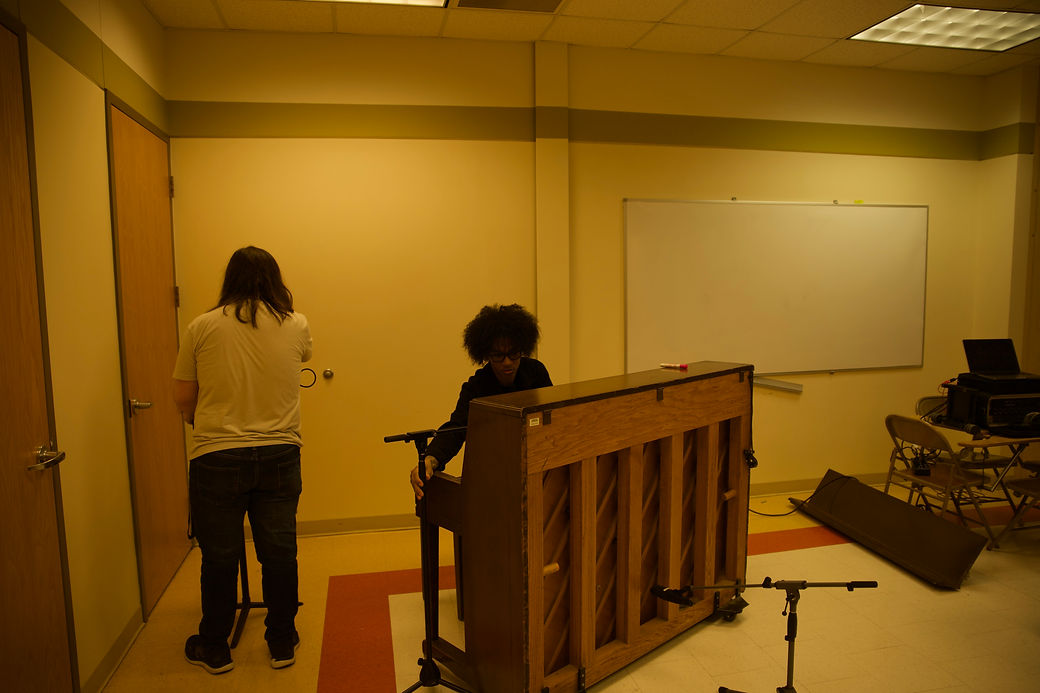
I chose to mic up and record a vintage upright Wurlitzer. My main instrument is Piano/keyboard, so discovering and trying unique and common recording and miking methods with this instrument was dope. My idea was to find something anything inspiring that could convey something smooth, felt, and emotional. I think it's key to recognize and learn historical, modern, and known methods for miking to effectively get the sound I want. Originally while brainstorming for this project, I read, watched, and researched methods and miking for grand pianos, uprights, and organs but one video stuck out from Universal Audio, it’s a very exhilarating hobby as you could guess. “Three ways to mic a piano with Jacquire King” by Universal Audio became my main reference after previewing several acoustic piano sources around campus and finally deciding that the perfect one for the project would be found in Steele Hall room B139 otherwise known as… “The classroom”. This was an ordinary classroom but specifically the room itself had unique characteristics that ultimately affected the recording. The room was incredibly reflective which wasn’t ideal, but it did have a unique vibe, the natural reverberations fit the characteristic of a medium-small room. The material I chose to record is also featured in the reference video it inspired me enough to put together an arrangement I decided to call “Link”.
Tracking
Tracking
I chose to mic up and record a vintage upright Wurlitzer. My main instrument is Piano/keyboard, so discovering and trying unique and common recording and miking methods with this instrument was dope. My idea was to find something anything inspiring that could convey something smooth, felt, and emotional. I think it's key to recognize and learn historical, modern, and known methods for miking to effectively get the sound I want. Originally while brainstorming for this project, I read, watched, and researched methods and miking for grand pianos, uprights, and organs but one video stuck out from Universal Audio, it’s a very exhilarating hobby as you could guess. “Three ways to mic a piano with Jacquire King” by Universal Audio became my main reference after previewing several acoustic piano sources around campus and finally deciding that the perfect one for the project would be found in Steele Hall room B139 otherwise known as… “The classroom”. This was an ordinary classroom but specifically the room itself had unique characteristics that ultimately affected the recording. The room was incredibly reflective which wasn’t ideal, but it did have a unique vibe, the natural reverberations fit the characteristic of a medium-small room. The material I chose to record is also featured in the reference video it inspired me enough to put together an arrangement I decided to call “Link/Hope”.


Breakdown/Key Takeaways
Reference
-
AKG c214 (matched pair) on high and low strings equally positioned parallel to the tonal center of my material
-
Sennheiser MD421 with cloud lifter at the bass of the Wurlitzer
-
Shure KSM44 in omnidirectional mode raised up and in the distance diagonally facing the Wurlitzer
-
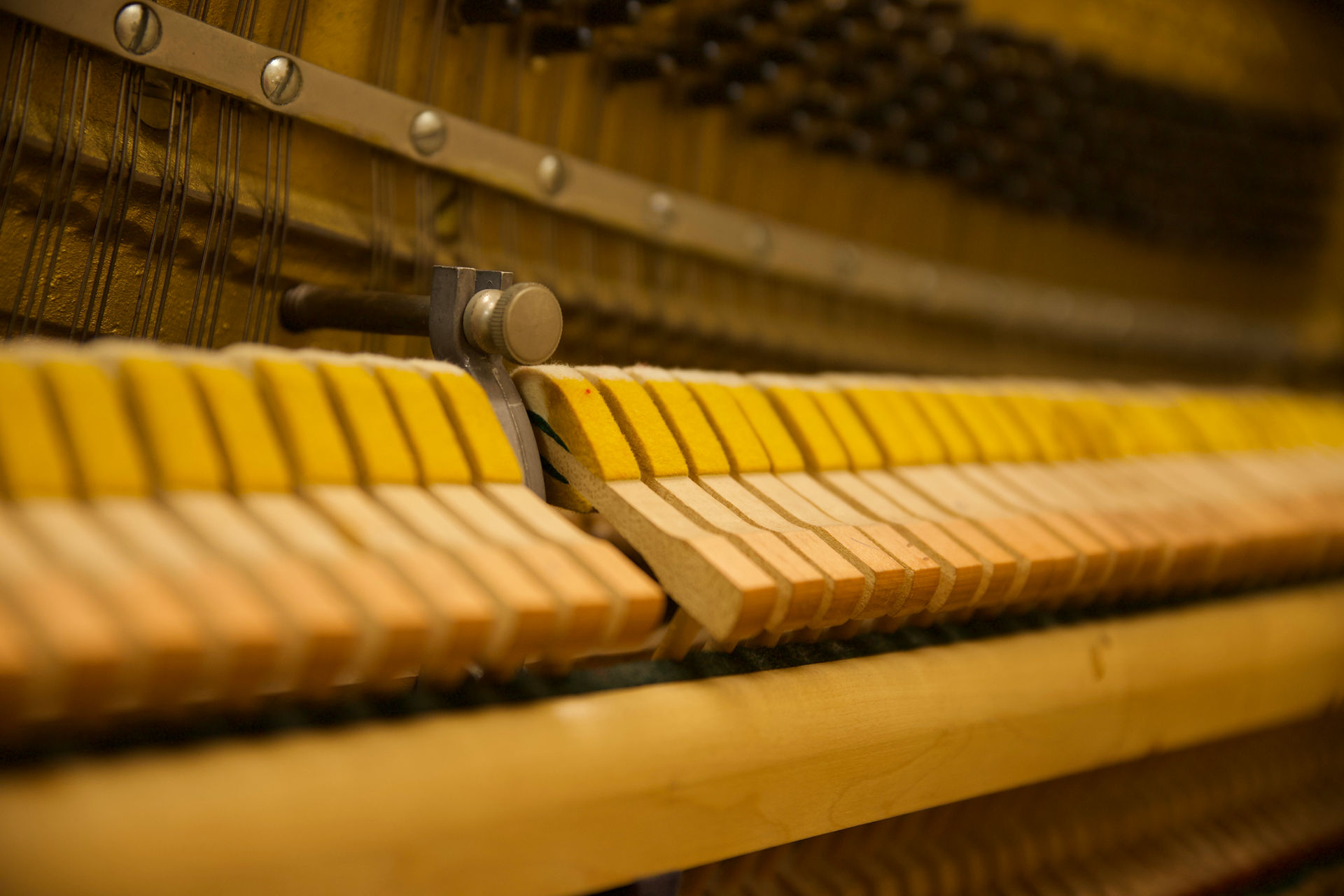
Used a tea rag to alter the timbre of the Wurlitzer
-
Despite the Wurlitzer's high midrange harshness and worn keys, I creatively used a tea rag to alter the timbre to a softer, felt tone. Tracked in Pro Tools with a mobile studio, I utilized AKG 214 condenser mics for detail, a Sennheiser MD421 for low mids, and a Shure KSM44 as a room mic for a warm, cinematic feel.
Post Production/Mixing
First, I organized my session. I went through playlists taking the parts best suited for the arrangement, organized audio that could be useful, and trashed audio that didn’t cut. Then, I checked the phase and found a slight but expected discrepancy between the pair of AKG c214s and aligned the phase manually. My tracks are labeled and color-coded routed to buses and routing folders eventually hitting the 2-bus for final polish, glue, and loudness. I started by listening to different takes splicing them together arranging sections, layering tracks, slight EQ, and compression to give me direction. I marked areas that I liked but needed rhythmic or melodic correction to come back to after my arrangement was in place. While listening I noticed that some audio has this static sound baked into it which I really couldn’t fix but I could work around. I used Pro Tools clip gain to lower some peaks and dynamic outliers. After I got my tracks organized and in an arrangement that I liked then I went on to EQ. Using Universal Audio’s emulation of the Pultec EQs I brought more clarity and tone to the 214’s by attenuating some low frequencies. On the foot pedal tracks, I also used a Pultec to add body, cut highs, and slightly attenuate to glue the mics together. On the room mics I just used similar settings tweaked them as necessary and utilized a Pultec HLF to get rid of irrelevant frequencies. I panned the low and high string mics left and right to a different extent throughout the arrangement. The room and foot pedal mics stayed relatively in the middle or slightly left-right. One thing that I wish I could’ve accounted for was the noise in the room I recorded, as I was applying compression (Overall between 1-2.5db max) I noticed the amount of noise from my mics came up considerably especially from the room mics being closest to the AC. I thought it was also cool in the beginning of the material there’s a pickup on beat 4, so I printed the metronome sound from the click track to sound like a movie is starting and it leads perfectly into the beginning of the piece. This is on the more felt artistic side of production, I had a voice memo of a car drive that had a mood similar to the piece, and it played throughout the whole thing. I did it to add character and ambiance and to further the distant yet present sound. I also created a couple of buses for delay (Galaxy Tape Delay, Echoboy), upward compression (OTT), New York style compression(Century Tube Strip/Studer a800), and a vibe bus (micro shift) with vibrato detune on it. I used a reverse reverb technique to transition between sections more seamlessly. Sometimes it's straight reverse reverb or a riser sample from my splice library. I used automation on various volumes and pans to give movement and progression to the mix. For the 2 Bus, I started with saturation. I love this plugin from Plugin Alliance called the Black Box. It’s my go-to other than Cradle the God Particle 2 amazing plugin for adding saturation, life, and presence to anything. Next, I opened another plugin from Plugin Alliance called bx_v3. I love this for the 2 bus because I have mid/side EQ, Left/right EQ, phase correlation meter, balance meters, a high pass knob that sums everything below the desired frequency to mono, and even dynamic EQ. I used this to clean up the overall tone, make it darker, and have more space in the middle since I plan on making this a fuller production, setting the “Mono-Maker’ to around 250hz, and widening everything slightly. Next, I used a Bus compressor from SSL to glue everything together. On the Master, I used an Oxford inflator for the lift it gave my whole mix. Finally, I used a limiter to bring the loudness up to compensate for different listening environments.


-
Organizing the session, I selected the best parts, checked for phase alignment, and labeled and color-coded tracks.
-
Using Pro Tools clip gain, I addressed dynamic outliers.
-
Tonal EQ involved Universal Audio's Pultec EQ collection to enhance clarity, tone, and remove irrelevant frequencies.
-
I panned the low and high string mics while keeping the room and foot pedal mics centered.
-
Post-production involved various effects and techniques, including reverse reverb transitions.
-
On the 2 Bus, I applied saturation with the Black Box plugin, used bx_v3 for EQ adjustments, SSL bus compression for cohesion, and Oxford Inflator on the master for an overall lift.
-
Despite overthinking the sonics, the mix turned out ambient, cinematic, and dark.
Breakdown/ Key Takeaways
FINAL
Thoughts
FINAL
Thoughts
Overall, this mix was relatively simple. I spent much time overthinking the sonics and not having fun experimenting and finding cool ways to make things sound good. A lesson I think a lot of talented people forget when the pressure is on. Although I expected a more forward present sound, I’m glad what came out was ambient, vintage, and dark. Going forward playing keys for recording I’m cutting my fingernails and playing less on the tips and more with the skin because the finger noise that the 214’s picked up was a lot. I learned I like to try new things and inspiring things can come out if you spend the time, care, and effort. Lessons learned included adapting playing techniques for recording and embracing experimentation. (for details and specifics look at the other writeup)